
Looking Beyond The Numbers: A Different Way to Evaluate Gold Projects

When investors evaluate a gold project, they commonly ask:
How many grams per tonne of gold are present? How thick are the mineralized intervals? How do the assay results compare to other projects?
These are important questions. Grade and grade x width are fundamental components of any mineral project and will always be an important consideration for investors and geologists alike. While grade × width can be a useful screening tool, experienced geologists recognize that no single number captures the full characteristics of a mineralized system.
In simple terms, Grade tells geologists how much gold is present within a sample. Geometry and location help them understand how that mineralization occurs within the broader system and whether the deposit can become and economic mine.
Many new high-grade discoveries are being made at increasingly greater depths. These discoveries can be significant, but deeper deposits often require more complex and expensive exploration and development programs to define and access.
By comparison, shallow gold deposits can offer advantages such as lower drilling costs and the potential for lower-cost mining relative to deeper deposits, however, these opportunities are becoming increasingly rare. Shallow deposits may also support simpler development scenarios and shorter timelines to production.
Location is another critical piece of the equation. Even a very promising deposit may face significant economic challenges if it situated in a remote region with limited infrastructure.
The challenges associated with developing remote projects, such as Ontario's Ring of Fire, illustrate how infrastructure and location can significantly influence a project's economic potential. Access to roads, power, skilled labour, and nearby services can significantly influence the cost and practicality of advancement and should always be considered when evaluating a project.
Understanding Geometry in Exploration
In simple terms, geometry refers to the shape, depth, orientation, thickness, and continuity of a mineralized system.
These characteristics help geologists understand how mineralization occurs within a deposit and influence how exploration programs are designed and carried out.
Two gold projects may report similar grades or comparable grade × width values while having very different geological characteristics. One project may contain mineralization hosted within narrow, structurally complex zones at depth. Another may contain mineralization within a broader, more continuous horizon located closer to surface with each presenting a different geological questions and exploration considerations.
One of the primary objectives of exploration is to build confidence in the geological interpretation of a mineralized system. Every drill hole provides information about the location, thickness, continuity, and characteristics of mineralization.
When mineralization occurs within a recognizable geological horizon, drilling can help geologists better understand how that horizon extends across a property and how mineralization is distributed within it. As additional information is collected, geological models can be refined, and exploration programs can be adjusted to test new targets or improve understanding of known mineralized areas.
For this reason, it is important to evaluate grade within the context of the broader geological system, including its geometry, continuity, and geological setting.
Geometry and Exploration Efficiency
The geometry of a deposit can influence how exploration programs are designed, how geological information is collected, and how mineralization is interpreted over time.
For example, shallow mineralization can often be evaluated using shorter drill holes than mineralization located at significant depth. As a result, exploration programs may be able to test more targets or collect more geological information within a given drilling campaign.
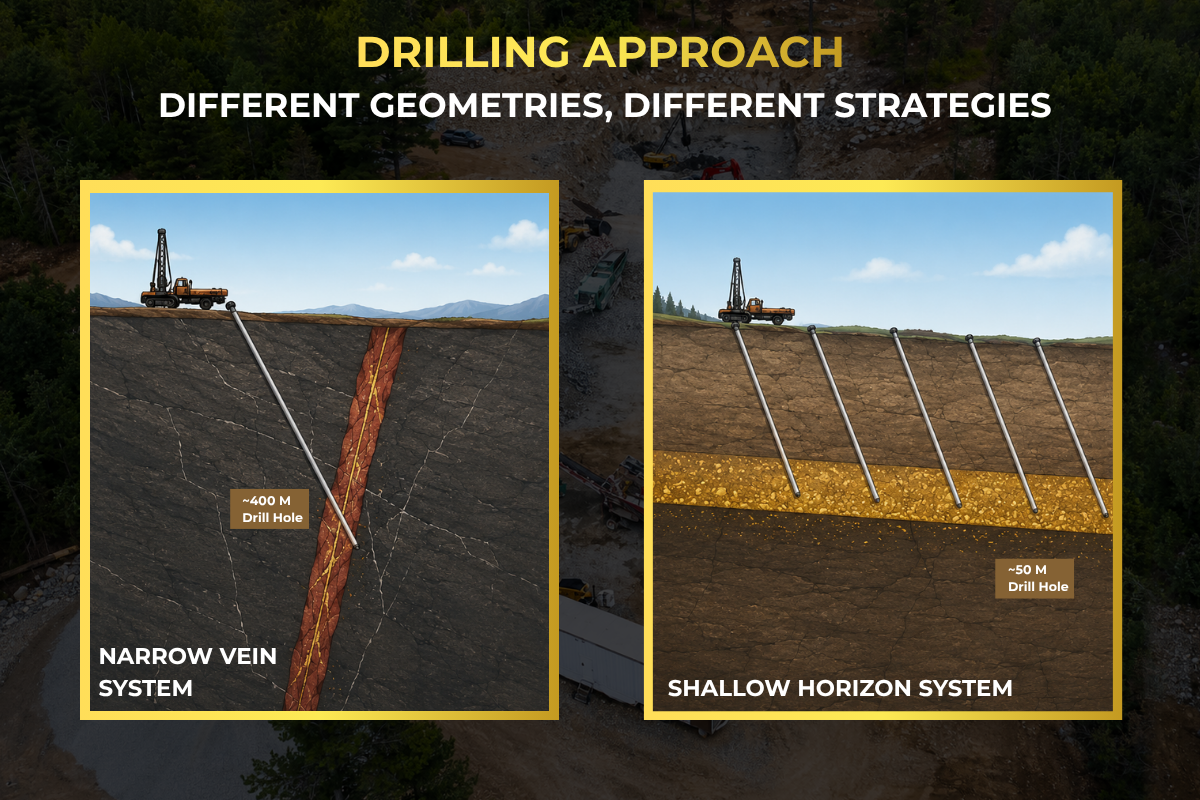
Similarly, mineralization that occurs within broad, laterally continuous horizons may be evaluated differently than mineralization hosted within narrow veins or complex structural systems. Each style of mineralization presents its own geological challenges, but the geometry of the deposit can influence drilling strategies, data collection, geological interpretation, and the technical and economic factors considered during project evaluation.
For investors, this is one reason geometry should be considered alongside grade and grade × width when evaluating exploration projects. The shape, continuity, and depth of a mineralized system can influence how geologists build confidence in their understanding of the deposit as exploration progresses.
It is important to note that geometry alone does not determine the economic viability of a mineral project. Grade, metallurgy, continuity, tonnage potential, permitting, infrastructure, market conditions, and many other factors must also be considered.
The Economics and Geometry of the Pardo Gold Project
The Pardo Gold Project is a paleoplacer gold system where gold occurs within ancient conglomerate horizons deposited approximately 2.4 billion years ago.
Rob McEwen shares what attracts him to the Pardo Gold Project, highlighting its strategic location and shallow, near-surface geometry.
Unlike many gold projects where mineralization is associated with steeply dipping veins or structurally controlled zones, Pardo's gold-bearing conglomerate horizons are generally shallow and flat-lying. These characteristics are noteworthy because they align with several of the attributes investors and geologists should consider when evaluating a project's potential.
The shallow nature of the mineralization allows broad portions of the system to be tested using relatively short drill holes and has supported large-scale bulk sampling programs at Pardo. The ability to extract and process substantial volumes of mineralized material has provided valuable geological and metallurgical information while also generating cash flow that has been reinvested into ongoing exploration and project advancement. This type of bulk-sample program is generally more feasible in laterally extensive, near-surface systems than in deposits where mineralization occurs in narrow, discontinuous zones at depth.
The Pardo Gold Project is situated in Ontario, approximately 65 kilometres northeast of Sudbury, one of the world's most established mining jurisdictions. Access to existing infrastructure, nearby services, and a skilled mining workforce can provide meaningful logistical advantages compared to projects located in more remote regions. The project's location has also allowed bulk sample material to be transported and processed at nearby facilities, an approach that would be considerably more challenging in areas with limited infrastructure.
Recent drilling has also identified gold mineralization within the Matinenda Layer, a separate conglomerate horizon located west of the Main Layer area. The presence of mineralization in multiple conglomerate-hosted horizons continues to expand the Company's understanding of the broader paleoplacer system and supports ongoing exploration efforts across the property.
As drilling progresses, Inventus continues to evaluate the extent, continuity, and characteristics of these horizons while advancing toward a maiden mineral resource estimate and further defining the potential of this near-surface, district-scale paleoplacer gold system.
Looking Beyond The Numbers
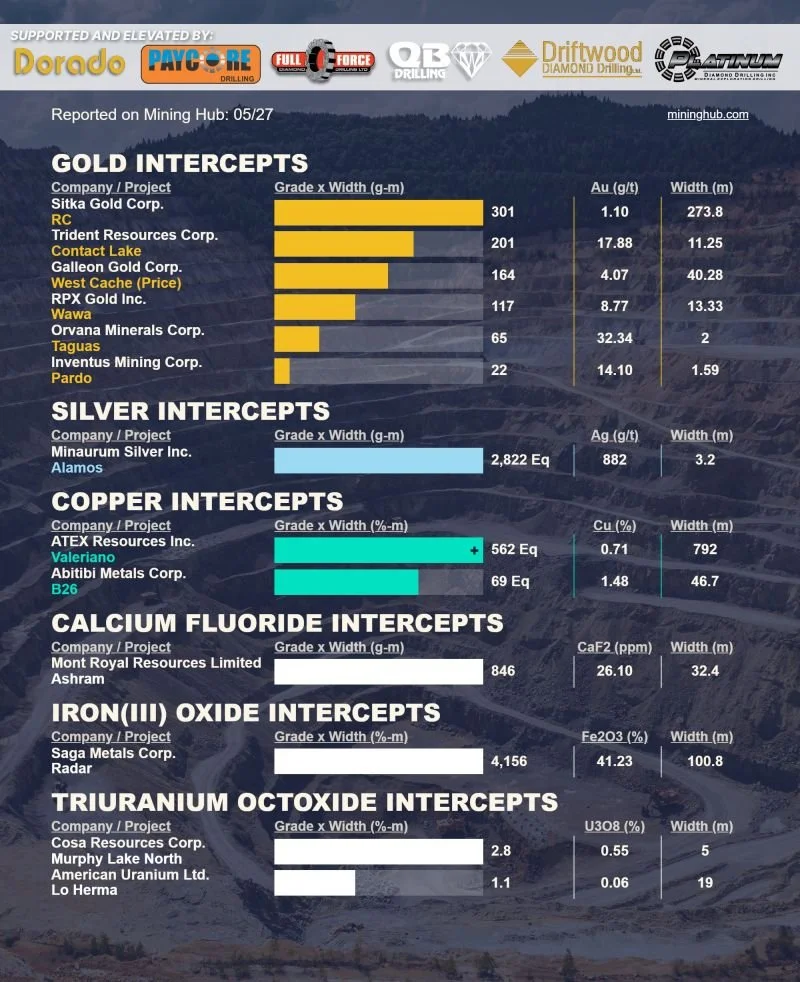
Pardo may not rank highest on a simple grade x width comparison. This is beacause grade x width does not tell the whole story. The mineralization at Pardo is shallow, flat-lying, and continues to return multiple strong gold intersections across several conglomerate layers as the system continues to expand.
For investors, understanding concepts such as geometry and location can provide additional insight when evaluating exploration-stage companies and comparing project potential.
Evaluating a gold project requires looking at the entire picture. Grade and grade × width provide valuable data points, but geometry, depth, location, and the broader characteristics of the mineralized system are often just as important in understanding a project's exploration and development potential.
At the Pardo Gold Project, the shallow, flat-lying nature of the mineralized horizons remains an important characteristic of the system and continues to guide ongoing exploration activities aimed at improving the Company's understanding of the deposit.
Investors interested in following the evolution of the Pardo Gold Project can subscribe to our newsletter and follow Inventus for future technical updates and educational content.
