
Front-Loaded Gold Recovery: What the Latest Heap Leach Testing Results Reveal About Pardo

Over the past year, shareholders have followed the progress of drilling and bulk sampling at the Pardo Gold Project. While each program serves a different purpose, they all contribute to the same objective: building the technical understanding needed to guide future development decisions.
The latest heap leach testwork advances that understanding by evaluating another key aspect of the project, specifically, how Pardo mineralization responds to heap leaching, and what those results could mean for future process design.
Why Early Recovery Matters
The headline result of up to 74.5% gold recovery is encouraging, but the recovery curve itself may be even more significant.
At a -1/4 inch crush size, the column recovered 64.3% of the contained gold within the first 27 days and 72.0% after 48 days. Extending the leach cycle to 78 days increased total recovery by only a further 2.5%.
The results indicate that most of the recoverable gold was extracted early in the leach cycle. From a metallurgical perspective, this is an important observation because it begins defining where the point of diminishing returns may occur. Rather than maximizing recovery at any cost, future optimization can focus on balancing recovery against cycle time, reagent consumption and overall operating efficiency.
The testwork also produced a favourable reagent profile. Cyanide consumption remained low, and no lime was required during the test. While additional testing is still needed, these are encouraging observations that will help guide future optimization work.
An Integrated Processing Strategy
While the heap leach results are encouraging on their own, their greatest significance lies in how they integrate with the broader metallurgical strategy being evaluated at Pardo.
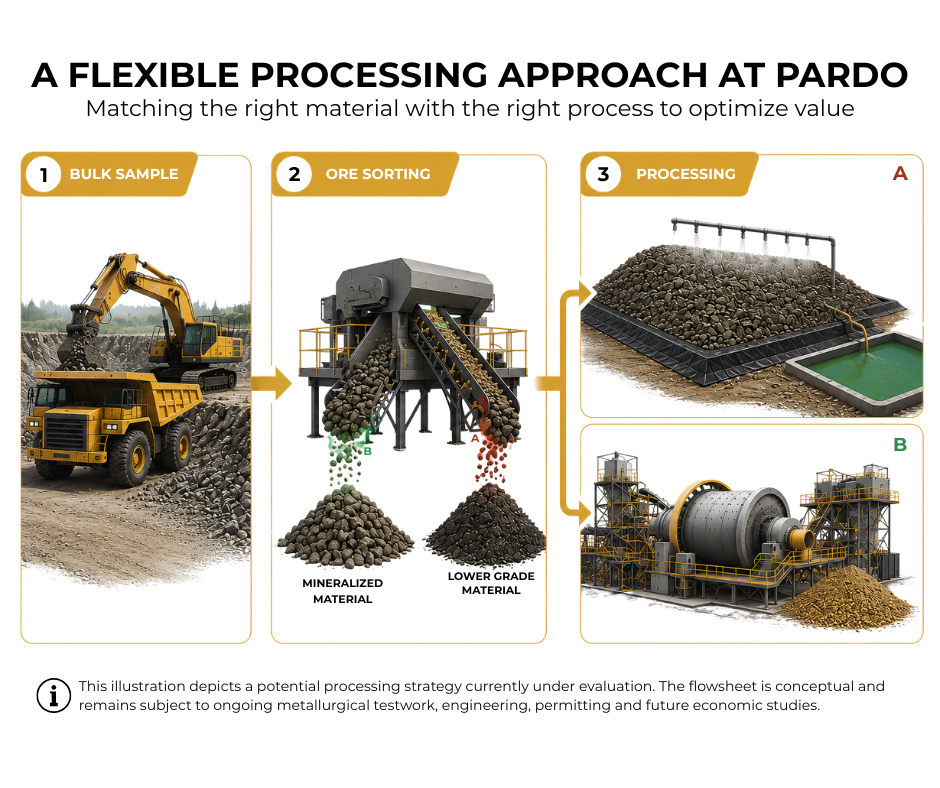
Inventus is currently advancing ore sorting testwork to determine whether mineralized material can be separated from lower-grade material prior to processing. If successful, this has the potential to generate two distinct product streams.
A higher-grade fraction could potentially be transported to an existing milling facility for conventional processing, while a lower-grade fraction could remain on site for heap leaching.
Rather than applying a single processing route across all mined material, the project could ultimately benefit from matching different grade mineralization with the processing method best suited to optimize the economics.
Although this integrated flowsheet remains conceptual and requires additional testing, engineering and economic evaluation, the latest heap leach results represent an important step toward determining whether that flexibility can be achieved.
The Next Phase of Metallurgical Evaluation
The current program tested a higher-grade composite from Trench 1. As noted by Process Mineralogical Consulting, those results cannot be directly extrapolated to lower-grade material, which must be evaluated independently.
That makes the next phase of testing particularly important.
Future work will focus on lower-grade mineralization and potential ore-sorting product streams while incorporating additional gold deportment, mineralogical, porosity and permeability studies. Together, these programs will help determine not only whether heap leaching is technically viable, but where it could fit within the overall processing strategy for Pardo.
Rather than providing a final answer, the latest testwork narrows the range of uncertainty and provides a stronger technical foundation for additional studies.
Each metallurgical program adds another layer of understanding. In this case, the results demonstrate that Pardo mineralization exhibits favourable early-stage leach kinetics while supporting continued evaluation of an integrated processing strategy that combines ore sorting, conventional milling and heap leaching.

